The Acoustic Impedance of the Boehm Flute:
Standard and Some Non-Standard Fingerings
J R Smith, N Henrich & J Wolfe
School of Physics
The University of New South Wales
Sydney 2052 Australia
Proc. Inst. Acoustics, 19, 315-330 (1997)
Abstract
The acoustic impedance Z(f) of the flute as a function
of frequency f has a range of about 70 dB. We report
here the use of a novel impedance spectrometer to measure the
acoustic impedance of the flute with a resolution of ±0.5 Hz,
a dynamic range of over 80 dB, and which makes the measurement
in 1 second. We report Z(f) for the standard fingerings over
the range C4 to F#7, and for selected non-standard fingerings
as well. These /music/flute/results explain some of the idiosyncracies
of the instrument well known to flutists, and in some cases
suggest ways in which these may be overcome.
Introduction
Musical instruments offer an interesting challenge to physicists
because musicians are sensitive to quite subtle effects in instrument
performance. In order to explain the features of a musical instrument
that are important to players and manufacturers, physical measurements
must be made with high precision and theoretical analyses must
include high order effects. We have begun a collaboration with
a renowned flute maker (Lehner Flutes Australia and The Woodwind
Group). The long term aim is to characterise the passive acoustic
properties of flutes and where possible to correlate acoustical
properties and differences in them with perceived differences
in performance [1]. We have begun
with a detailed study of the linear acoustics of a standard
flute over a range of fingerings.
In this paper we report precise and rapid measurements of
the impedance of a flute at the embouchure hole. Impedance
measurements offer several advantages, providing not only
information on the resonance frequencies, but also their relative
magnitudes and sharpness. For any given fingering, the Q of
the various resonances and their deviations from an exact
harmonic series is important in determining stability of intonation
- approximately what many musicians call being well 'centred'.
They are also important in the ease of 'speaking' or 'starting'
of notes, and in transitions between notes.
Impedance measurements on the flute impose several technical
problems. Although the impedance curves for instruments with
reed and lip-reed instruments have been measured for many
years, e.g. [2,3], such instruments
sound at frequencies determined by their impedance maxima.
The air column of the flute is excited by an air-jet at an
embouchure hole which is open to the external air, so the
flute sounds at frequencies near the impedance minima. Impedance
measurements should thus cover a very wide dynamic range,
often exceeding 60 dB.
For the player and maker, all of the notes are virtually
equally important so all of the standard fingerings must be
studied. Professional players use alternate fingerings in
some circumstances, and the contemporary repertoire requires
special fingerings for microtones, multiphonics and different
timbres. Measurements should be rapid for this reason, and
also if they are to be used in diagnosis of problems and successive
improvements in flutes. In this study we use a 'real time'
technique developed for research into the acoustical impedance
of the vocal tract [4,5]. We use
a frequency spacing of 1 Hz and determine the detailed shape
of the impedance, and thus the resonances, to ±0.5 Hz.
Apparatus
The acoustic impedance spectrometer
Details of the spectrometer have been given elsewhere [6].
In this application it synthesizes a waveform which is the sum
of 2801 frequency components equally spaced at 1 Hz intervals
between 200 and 3000 Hz. This waveform is amplified and connected
to a loudspeaker that is matched to a high value acoustic resistor
via an exponential horn (see Figure 1a). This resistor thus
provides a nearly ideal source of acoustic current if the impedance
of the load is sufficiently small. The resultant presssure response
when the acoustic current is coupled to a load is detected by
a small electret microphone and amplified by a low noise pre-amplifier
with computer-controlled gain. This version of the instrument
used a Macintosh IIci computer with a 16-bit Analogue/Digital
card (National Instruments NB-A2100).

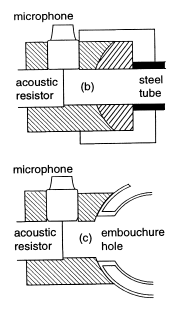
Figure 1. Schematic diagrams indicating (a) the
acoustic impedance spectrometer, and its connection to (b)
the reference cylindrical pipe and (c) the embouchure hole
of the flute.
Calibration
In the calibration procedure, an electrical waveform with
a power spectrum denoted by VREF(f) is synthesized and converted
by the loudspeaker, horn and high acoustic resistance into
an acoustic current uREF(f), which is coupled to a reference
load ZREF(f). The acoustic pressure is measured via the microphone
and the pressure spectrum pREF(f) calculated. A new waveform
with Fourier components proportional to VREF(f)/pREF(f) is
then synthesized. This produces a spectrum that is flat (i.e.
frequency independent to ±0.1 dB rms) when pREF(f) is measured.
The system was calibrated using a resistive load as ZREF.
This was a semi-infinite pipe - (in practice a 42 m stainless-steel
pipe with an internal diameter of 7.8 mm, i.e. slightly smaller
than the embouchure hole - see Figure 1b). For measurements
when the frequency spacing exceeds 4 Hz, the calibration can
be performed before the echo returns and so the 42 m tube
is effectively infinite. For 1 Hz resolution, a 1 s waveform
was required. Fortunately, the attenuation in a tube of this
diameter is approx. 0.11 per metre [7]
at 200 Hz, so the echo returned with a loss of 80 dB and thus
made negligible change in the amplitude measured in the calibration
signal. The -18 dB level on our plots of Z(f) corresponds
to 2.2 MRayl.
Coupling the flute to the spectrometer
The acoustic current source with a flat spectrum uREF(f) was
then coupled to the embouchure hole of the flute using the
measurement head shown in figure 1c. It was designed to measure
the impedance at the embouchure hole when it is loaded with
an impedance approximately equal to the radiation impedance
of the hole with the player's lips and face acting as a baffle.
We report measurements for frequencies below 3 kHz and thus
with wavelengths exceeding 100 mm. This is rather larger than
the dimensions of the measurement head and so a plane wave
approximation should be valid. The radiation impedance of
a baffled pipe of radius a is approximately equal to
that of an ideal tube with a length L = 0.85a. The
radiation impedance ZE at the embouchure hole could
thus be approximated by
ZE = jwrL/SE = 0.48 jwr/(SE0.5)
where SE denotes the effective area of the embouchure
hole, w = 2pi.f and r denotes the density of air.
In the playing position, the embouchure hole is partially
occluded by the lower lip leaving open a fraction g.
Furthermore the face of the player will act as a baffle over
a fraction (1-h) of the solid angle available for radiation.
ZE is thus increased to ZE = 0.48 jwr/h(gSo)0.5
when the flute is in the playing position and where So
denotes the unencumbered area of the embouchure hole.
The short measurement tube of length LT that couples
the spectrometer to the embouchure hole has an area ST
and its impedance is ZT = jwrLT/ST. ZT will thus equal ZE
when LT = 0.48ST/h(gSo)0.5 where So is the
actual area of the embouchure hole (approx. 80 mm2).
The factor g will vary because any one player will
occlude the hole by different amounts for different notes,
and h will also vary among players because of the shape
of their faces. Consequently the term hg1/2 cannot
be known precisely, although we suspect it is less than 0.5.
For our adaptor we chose a tube with ST less than So
because this makes positioning less critical, and also because
it improves the plane wave approximation. The selected tube
had a diameter of 7.8 mm and consequently LT = 7 mm if we
assume h = g = 0.5.
Impedance measurements on the flute
The measured pressure spectrum p(f) will be given by
p(f) = uREF(f) ZFLUTE(f) = pREF(f)ZREF(f) ZFLUTE(f)
= constant . ZFLUTE(f)/ZREF(f)
where the constant is known from the calibration procedure described
above. The semi-infinite pipe should exhibit a frequency-independent
acoustic resistance. Consequently the measured pressure spectrum
p(f) immediately yields ZFLUTE(f).
The time taken to acquire the data to calculate each plot
of Z(f) was only 1 second, although calculation of the Fourier
components from the data sampled at 44.1 kHz took considerably
longer. To allow replication by others, all measurements were
made on a basic production line flute (Pearl PF-661, closed
hole, C foot) rather than the finer instruments of our industry
collaborator. Measurements were made in dry air with T = 19.5±0.5
C.
Results
The impedance for different timbres 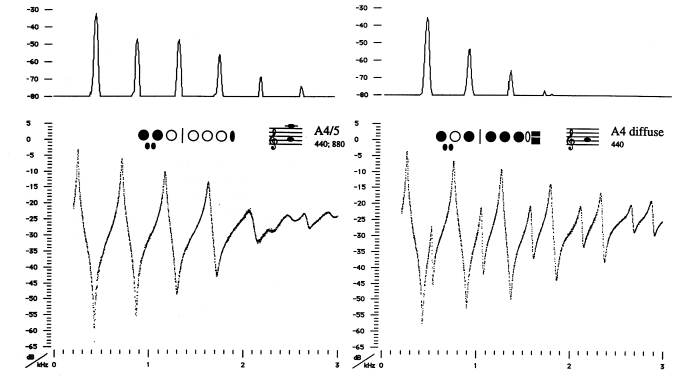
Figure 2 The lower plots show the impedance spectra
of a flute measured at the embouchure hole with (a) the conventional
fingering for A4/5 and (b) an alternate fingering for A4.
Each plot is a set of points representing measurements at
2801 different frequencies. The upper continuous lines show
the measured pressure spectrum from the sound of another flute
played with the same fingering.
Figure 2a shows Z(f) for the standard fingering used to
play both A4 (440 Hz) and A5. The first four tone holes are
closed and all others are open. The inset shows the fingering
(some keys close two tone holes). Below about 1.9 kHz, the
curve may be compared with that for a simple cylinder of length
chosen to sound A4. Above that frequency, the open tone holes
downstream produce subtle effects. Even 'venting' (opening
or closing the seventh tone hole downstream) makes a clearly
observable difference to Z(f), though it has little effect
on the note produced. The flute is played with the embouchure
hole at least partly open, and so the minima of Z(f) correspond
to playing frequencies. For the fingering A4/5 shown the flute
can be made to play notes near each of at least the first
four of these minimum frequencies by blowing harder in turn,
and adjusting the embouchure. (A clarinet, on the other hand,
is played with a mouthpiece and reed that more closely approximates
a closed end. The clarinet too is cylindrical, to first order,
and it plays at maxima of impedance. A clarinet mouthpiece
driving this load would be expected to sound the frequencies
of the maxima - i.e. approximately the odd harmonics of a
fundamental roughly half that of the flute.) A detailed analysis
of the flute has been published by Coltman [8]
among others.
The plots in Figure 2a show an asymmetry of the peaks in
Z(f) for the flute which is not seen in Z(f) for a simple
pipe. This may be qualitatively explained as follows: One
difference between a flute and a simple cylinder is that the
embouchure hole is displaced from one end, and that it is
smaller than the diameter of the flute. Further, it is in
general partly occluded by the player's lower lip, as discussed
above. The reduction in diameter is expected to have relatively
little effect on the impedance maxima, where the flow is low
and pressure high. It is expected to have a rather larger
effect on the impedance minima, where flow is high and pressure
is low. Thus the minima are flattened with respect to the
maxima.
Figure 2b shows Z(f) for another fingering for A4 (A4/II
from [9]). 3.2 This fingering produces
a diffuse, dark timbre, some broadband jet noise and a limited
dynamic range. It overblows to rather brighter notes at approximately
A5, E6 and A#6.
Impedance for different constructions
Can measurements of Z(f) explain superiorities in actual performance?
Here we give a simple example using the same flute with no
geometric changes.

Figure 3 The impedance spectra Z(f) for the note
E6 on a flute with and without the 'split E' mechanism. The
vertical arrows indicate the frequency at which this note
sounds.
The two spectra in figure 3 show the effect of a 'split
E' mechanism. This fingering (and the spectra) can be considered
in (at least) two different ways. If one regards it as E4
with the third finger of the left hand raised, then it produces
the fourth harmonic of this note. In a flute with the mechanism,
raising that finger opens one tone hole, which forms a pressure
node about 1/4 of the way along the tube. Without the mechanism,
two adjacent tone holes are opened. This has a similar effect,
but in this case the E6 is less reliable at pianissimo (notice
the shallower, broader minimum indicated by the arrow) and
difficult to play cleanly under a slur from A4 or A5. One
may also think of this fingering as a perturbation of that
for A4/5 (Fig 2a) with some holes closed downstream. Notice
how Z(f) of the split E version is more dissimilar to Z(f)
for A4/5, which explains the increased ease of the slur A4/5-E6.
The impedance for 'multiphonics'
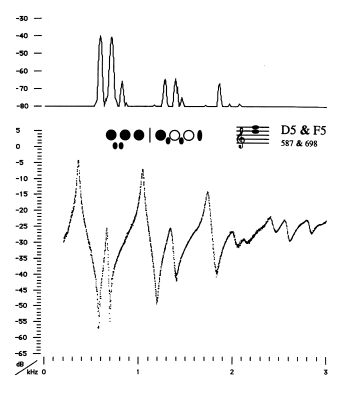
Figure 4 The impedance spectrum (lower curve)
and sound pressure spectrum (upper curve) for a fingering
that produces 'multiphonics' - it plays D5 and F5 simultaneously.
The peaks in the sound spectrum have a common factor of approx
120 Hz, which is presumably the periodicity of the air jet.
Impedance for the standard fingerings
The impedance spectra for the standard fingerings between
C4 and F#7, and those for selected non-standard and multiphonic
fingerings are available at our website -
/music/flute/.
References
- J WOLFE & J SMITH, 'A comparison of the acoustic impedances
of flutes - a preliminary study', Proc. of International
Symposium on Musical Acoustics - Dourdan, pp. 100-106
(1995)
- J BACKUS, 'Input impedance curves for the brass instruments',
J. Acoustic Soc. Am., 49: pp. 470-480 (1976)
- D SHARP, D M CAMPBELL & A MYERS, 'Input impedance measurements
on wind instruments using pulse reflectometry', Proceedings
of International Symposium on Musical Acoustics - Dourdan,
pp. 75-78 (1995)
- A DOWD, J SMITH & J WOLFE, 'Real time, non-invasive measurements
of vocal tract resonances: application to speech training',
Acoustics Australia, 24: pp. 53-60 (1996)
- J EPPS, J SMITH & J WOLFE, 'A novel instrument to measure
acoustic resonances of the vocal tract during speech', Measurement
Science and Technology, in press (1997)
- J WOLFE, J SMITH, G BRIELBECK & F STOCKER, 'A system for
real time measurement of acoustic transfer functions', Acoustics
Australia, 23 (1): pp. 19-20 (1995)
- N H FLETCHER & T D ROSSING, 'The Physics of Musical Instruments',
Springer-Verlag, New York 1991
- J W COLTMAN, 'Acoustical analysis of the Boehm flute',
J. Acoustic. Soc. Am., 65: pp. 499-506 (1979)
- R DICK, 'The other flute', Multiple Breath Music Company
1989
The support of the Australian Research Council is gratefully
acknowledged. We would also like to thank John Coltmann, Neville
Fletcher, John Tann and Mark O'Connor (Lehner Flutes Aust
and The Woodwind
Group) for their assistance.
John Smith / jrs@newt.phys.unsw.edu.au
|